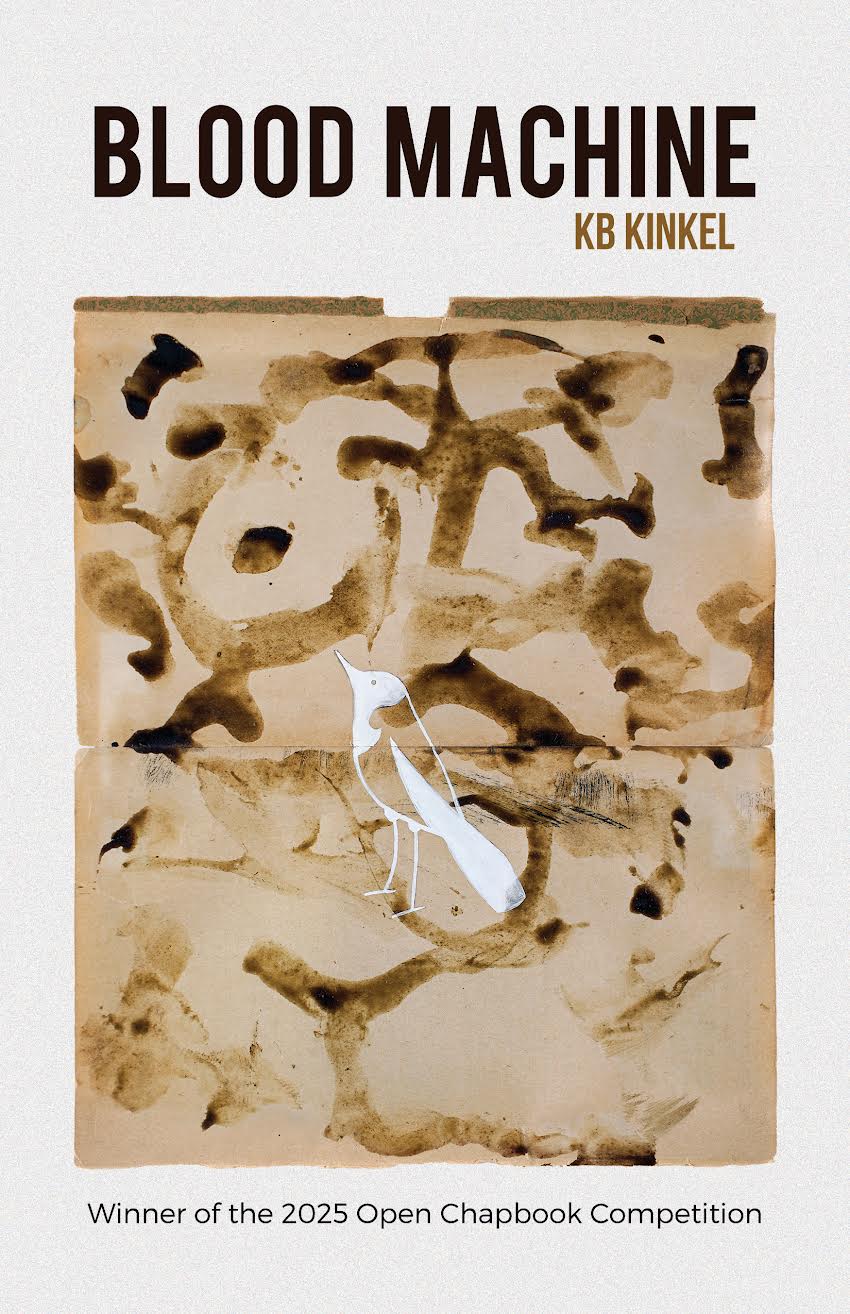
Blood Machine by KB Kinkel begins with a poem called “Well,” in which the speaker peers down through an expanse of time-considering almost the three decades of surveillance, ecological destruction, xenophobia, and violence that have defined their adolescence and early adulthood-and asks, “how did we get here?” These poems of witness, excavation, and extraction sift through artifacts of cultural memory, beginning with the literal and aesthetic detritus of 9/11. They work to locate the present moment within an unfolding series of violences beginning with, or significantly informed by, the turn of the ‘new millennium’-an event that coincides with the speaker’s own coming-of-age and unstable transition into gender, adulthood, and citizenship.
The poems in Blood Machine juxtapose languages that vary from deep time and evolution (as in “Transmigration” and “Recambrian”), to archival and found materials (“Paper, Recovered” and “[sound of water falling / and cars – ]”) as a means of tracing a personal and cultural lineage to the present. Kinkel uses ekphrasis to engage with twentieth and twenty-first-century visual artists (Marcel Duchamp, Damien Hirst, Eric Fischl, Mona Hatoum) whose works explore violence and representation at the turn of the century, or who engage directly (and sometimes unintentionally) with the cultural narrative of 9/11. Not quite an elegy, and neither fully an archive, Blood Machine resists any one rhetorical mode for considering post-9/11 artworks and documentation. Instead, these poems ask their readers to look closely and continuously at one of many defining moments of twenty-first-century art and violence to see what has been omitted, and what such reconsideration might reveal about our present moment.
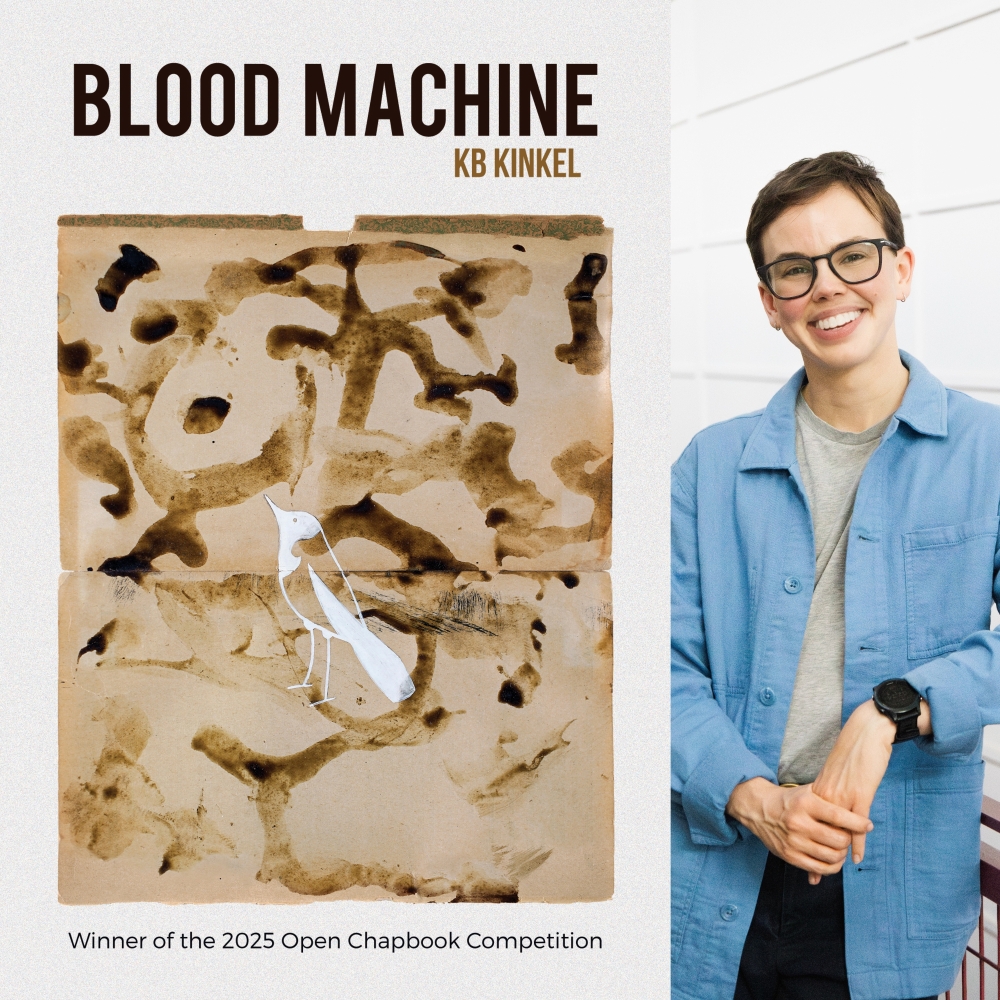
Image courtesy of Finishing Line Press. Author photo by Dee Tran.
ADVANCED PRAISE FOR BLOOD MACHINE
“KB Kinkel‘s poems enact human dignity, never forgoing mystery. They invite a reader into the violence and grief of 9/11 without any journalistic explanation. Exploring fear and love in equal measure, these ekphrastic poems contemplate, transform, and renew not only works of art but also objects–handwritten notes–recovered from “the dust that settles into all things.” In “Loss: Ambiguous,” a moving list poem made up entirely of questions, the speaker asks “Has anyone tried to comfort you?” and also asks “Do you hear those crickets?”: the tonal range here, as in so many of the poems–with their juxtapositions of high and low, mundane and cosmic, grieving and consoling–energizes a debut intent on reminding us that it is “impossible” to “return / to a previous world.””
–Catherine Barnett, author of Solutions for the Problem of Bodies in Space (Graywolf Press, 2024).
“KB Kinkel‘s fierce chapbook, Blood Machine, accomplishes what few manage in full-length collections: the creation of a small universe in which readers can immerse themselves, assured by poems so rigorous and exact in their phrasing that they feel hewn, sculptural, even preordained. Revisiting 9/11 and our current ecological collapse—crises we have been urged to distract ourselves from with consumerism and magical thinking—the poet provides us with ways of locating ourselves in geologic time, in geopolitical interconnectedness, and in the genuine porousness between event and history, environs and humanness. With nods to Baudrillard and Bidart, Duchamp and Fischl, Kinkel asks us to think about our most pressing questions in ways that enable us to perceive, and reconceive, our vulnerability and our yearning.”
–Heather Treseler, author of Auguries & Divinations, recipient of the 2025 Massachusetts Book Award
 KB KINKEL